
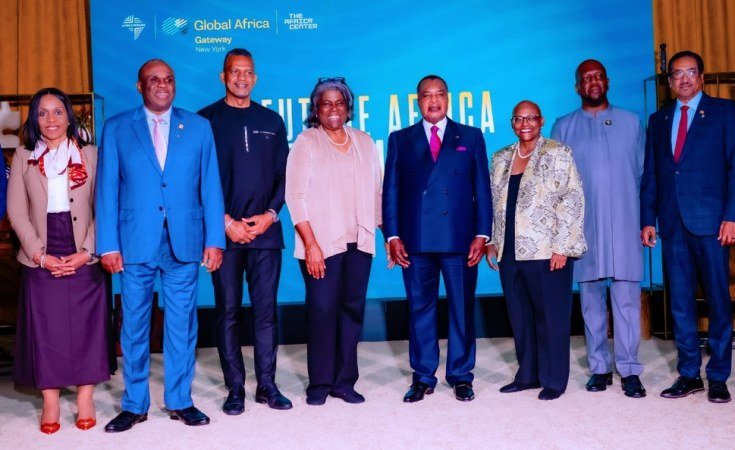
Afreximbank President and Board Chairman Professor Benedict Oramah has urged Africans and the global diaspora to transform their shared cultural heritage into a foundation for economic power and global influence.
Speaking at the Future Africa Forum 2025 held at The Africa Center in New York, Professor Oramah delivered a powerful keynote address under the theme “From Heritage to Prosperity Leveraging Cultural Roots to Promote Global Africa.”
The high-profile event brought together heads of state, global investors, policymakers, entrepreneurs, and cultural icons from across Africa and the diaspora. Among those in attendance were Republic of Congo President Denis Sassou Nguesso and The Africa Center Board Chairperson Jendayi Frazer.
Professor Oramah said Africa must recognise itself not just as a continent but as a global civilisation of nearly two billion people linked by shared ancestry, history, and destiny.
He told the audience that Africa’s greatest untapped asset lies in its cultural and ancestral connections, which extend across every continent. He said these ties can power a new era of trade, investment, and innovation that places Africa at the heart of global prosperity.
“The African in Accra and the African in Atlanta are bound by a common heritage and a shared destiny,” he declared, urging Africans everywhere to channel their collective identity into coordinated economic strength.
He noted that Africa’s diaspora already contributes more than 100 billion dollars annually through remittances alone, but its true potential extends beyond money. Its talent, creativity, and global networks, he said, represent “Africa amplified.”
Professor Oramah said Afreximbank has worked to institutionalise the “Global Africa” concept since 2018, expanding the traditional notion of intra-African trade to include all people of African descent worldwide.
Through the Bank’s Diaspora Strategy, he said, Afreximbank has mobilised investments, strengthened remittance-backed financing, supported creative industries, and advanced cross-border cooperation.
One of the bank’s most visible achievements, he said, is the Global Africa Gateway launched in New York in 2024. The centre serves as a bridge between Africa and its diaspora, hosting cultural, trade, and investment programmes that connect African and African-American entrepreneurs.
The Gateway’s Diaspora Internship Programme has already placed young African Americans in leading African corporations, fostering professional exchange and cultural understanding.
Professor Oramah also highlighted the success of the AfriCaribbean Trade and Investment Forum (ACTIF), first launched in 2022. The 2025 edition in Nassau, The Bahamas, drew over 2,100 delegates from 80 countries, including 11 heads of state, and generated more than 300 million dollars in new trade and investment deals.
He said the bank’s growing partnership with the Caribbean region marks a new phase of Pan-African cooperation, with 13 CARICOM nations now Afreximbank members and 11 having ratified the Partnership Agreement.
Afreximbank’s regional office in Barbados is already operational, with a 180 million dollar Africa Trade Centre under construction to serve as a hub for trade and business integration.
So far, more than one billion dollars of a three billion dollar commitment has been disbursed across sectors such as climate adaptation, tourism, renewable energy, sports, and infrastructure.
The bank is also working with CARICOM to establish a Caribbean Eximbank dedicated to financing industrialisation and innovation and with the Caribbean Development Fund to raise 250 million dollars for resilience through the Growth, Resilience, and Sustainability Fund.
Professor Oramah said these initiatives point toward the creation of a larger structure he called the Global Africa Commission.
He described it as a coalition uniting the African Union, CARICOM, Latin America, and diaspora institutions to harmonise trade, investment, and human development policies among people of African descent worldwide.
The commission, he explained, would help strengthen Africa’s collective voice in global affairs and ensure its cultural and economic weight is felt in global decision-making.
In his emotional closing remarks, Professor Oramah reflected on his tenure as Afreximbank President, saying the progress made proved that Africa’s destiny lies in unity and self-determination.
“If I leave a legacy, let it be this Africa and its diaspora are indivisible, united by heritage, empowered by commerce, and destined for greatness,” he said to applause from the audience.
He added that the bridges built between Africa and its diaspora must evolve into highways of trade, investment, culture, and shared prosperity.
The Future Africa Forum, an annual gathering hosted by The Africa Center, focuses on charting new partnerships for sustainable development and cultural renaissance across Africa and the diaspora.
This year’s forum was hailed as one of the most consequential since its inception, as it captured a growing consensus that Africa’s future prosperity must be built on unity, culture, and global collaboration.


