
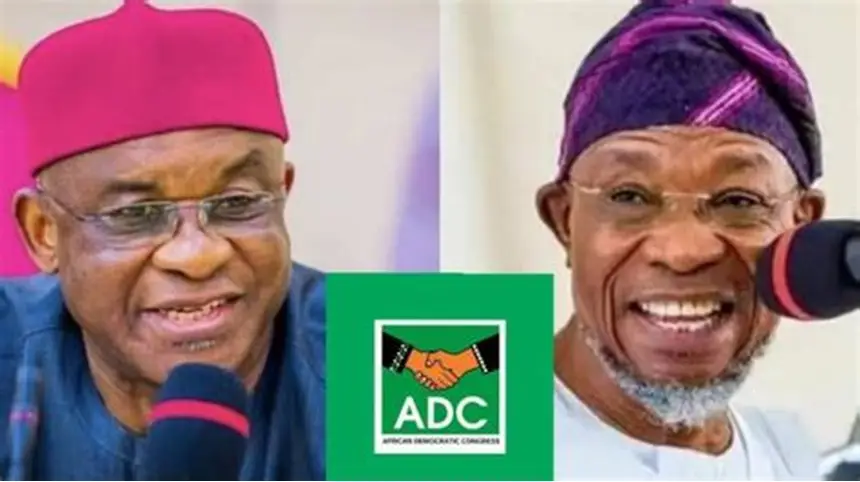
The former Secretary to the Government of the Federation’s explosive departure from the opposition coalition lays bare the fragility of efforts to mount a credible challenge against President Tinubu’s re-election bid.
DATE: June 7, 2026
Nigeria’s opposition landscape has been thrown into fresh disarray following the resignation of former Secretary to the Government of the Federation Babachir Lawal from the African Democratic Congress, a departure accompanied by incendiary allegations of electoral manipulation that have reignited national debate about the integrity of Nigeria’s democratic processes ahead of the 2027 general elections.
Lawal, who served as SGF under former President Muhammadu Buhari and has been one of the most prominent northern politicians in opposition circles, announced his exit from the ADC on grounds that the party’s recently concluded presidential primary had been comprehensively rigged to produce a predetermined outcome favouring former Vice-President Atiku Abubakar.
The development comes at a particularly sensitive moment in Nigeria’s political calendar, with parties and coalitions jostling to define their 2027 positioning. Lawal’s exit and his remarks are likely to complicate opposition efforts to present a united front against the ruling All Progressives Congress.
In a formal statement, Lawal declared that the ADC primaries had been rigged at every level to deliver Atiku Abubakar as the party’s presidential candidate. He described the process as a fundamental violation of internal democracy and said he was unwilling to participate in what he characterised as a rigging machine. His language was blunt and politically significant, given his standing within northern political networks that any credible presidential campaign must court.
Lawal went further, making a remarkable claim during a national television appearance that has since reverberated across political commentary circles. Asked whether President Tinubu was already positioned for victory in 2027, he suggested that if electoral manipulation determined the outcome of the poll, Tinubu would be effectively unbeatable. His remarks were interpreted by observers as simultaneously a critique of the opposition’s internal conduct and an implicit acknowledgement of the incumbent’s political machinery.
Despite his sharp criticism of the former vice-president, Lawal stopped short of endorsing any alternative candidate for the 2027 election. He questioned Atiku’s capacity to mount a genuine challenge to Tinubu, citing concerns about the former vice-president’s record on security and what he described as insufficient engagement with the crisis of violence affecting parts of northern Nigeria. Atiku and the ADC leadership denied the rigging allegations, with Atiku dismissing Lawal’s charges as products of personal disappointment rather than credible political analysis.
Read More: Nigeria’s Digital Finance Revolution: How CBN PSV 2028 Positions Africa’s Largest Economy as the Continent’s Payments Powerhouse
The political fallout from Lawal’s exit has been swift. It has drawn fresh attention to the broader challenges facing opposition parties in Nigeria, including the difficulty of maintaining coalition discipline, the tension between political ambition and institutional integrity, and the structural advantages enjoyed by incumbents in Nigeria’s electoral environment. Civil society groups and electoral reform advocates have used the episode to renew calls for urgent electoral reforms ahead of 2027.
The European Union Ambassador to Nigeria, Gautier Mignot, has separately reaffirmed the EU’s commitment to supporting Nigeria’s democratic process in the lead-up to 2027, citing planned technical assistance for INEC, civil society organisations, and political parties. However, the depth of the current political crisis suggests that external goodwill alone will be insufficient without meaningful internal party reform.
TODAY’A KEY HIGHLIGHTS
- Former SGF Babachir Lawal resigns from the ADC, alleging the presidential primary was rigged in favour of Atiku Abubakar.
- Lawal warned on national television that Tinubu would be virtually undefeatable if electoral manipulation determined the 2027 outcome.
- Atiku denied the allegations, describing Lawal’s claims as motivated by personal disappointment.
- The development exposes deep fractures within Nigeria’s opposition coalition ahead of the 2027 elections.
- EU has pledged technical support for Nigerian democratic institutions, including INEC, ahead of 2027.


