
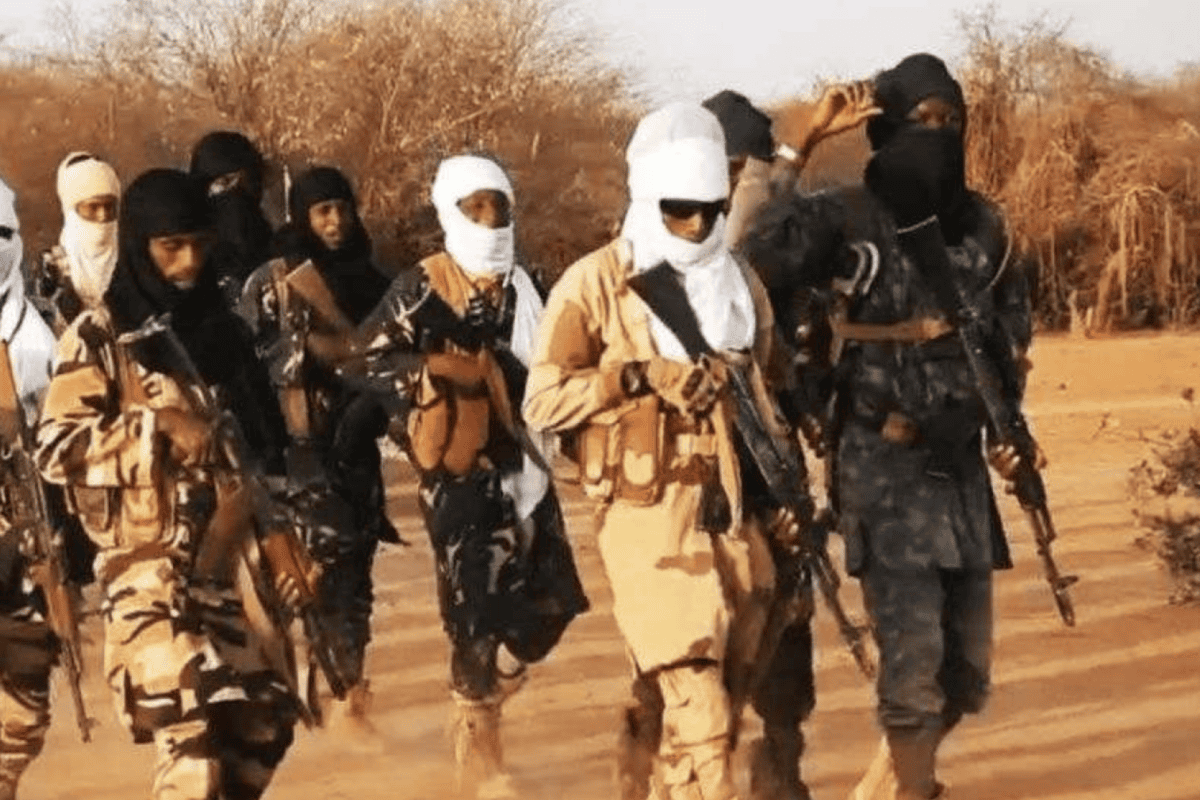
West Africa’s security architecture is fracturing along lines that the international community has not yet found an effective strategy to address, as military governments in Mali, Burkina Faso, and Niger continue losing territorial control to jihadist groups despite their expulsion of French forces and alignment with Russian military contractors.
The al-Qaeda-linked Jamaat Nusrat al-Islam wal-Muslimin, known as JNIM, has escalated its campaign in Mali beyond conventional insurgency into what analysts describe as economic warfare. Since September 2025, JNIM has imposed oil blockades on Mali’s supply routes, systematically strangling the country’s fuel supply and creating cascading economic damage across commerce, agriculture, and government operations. In Burkina Faso, armed groups have cut off food and essential supplies to thousands of civilians, worsening what is already one of the world’s most severe humanitarian situations.
Russia’s Africa Corps, which replaced French and UN peacekeeping forces at the invitation of junta governments, has not stabilized these countries. The juntas’ central promise, that they would restore security where Western partners had failed, has produced the opposite outcome. Violence has intensified, civilian displacement has accelerated, and governance capacity has further degraded.
Benin now represents the most immediate new flashpoint. A recent coup attempt in Cotonou triggered a Nigerian-led ECOWAS intervention that received French surveillance assistance, demonstrating that the alliance between Paris and anglophone West African nations remains operative even as France’s relationship with the Sahel’s francophone juntas has completely collapsed. France is actively rebuilding its regional footprint through diplomatic and trade relationships with Nigeria, Ghana, and Senegal, effectively drawing a new map of Western partnership in West Africa that bypasses the junta-led states.
The junta alliance among Mali, Burkina Faso, and Niger, formalized in the Alliance of Sahel States, has sought to recruit additional members from neighboring countries. Regional analysts warn that political instability could spill into anglophone nations along the Gulf of Guinea coast, where governance challenges, youth unemployment, and economic pressure from the global energy crisis create conditions that authoritarian movements can exploit.
For the Economic Community of West African States, the crisis presents an institutional existential challenge. ECOWAS imposed sanctions on the junta states after their coups and was met with defiance and withdrawal threats. The bloc has limited coercive capacity and its member states have divergent interests regarding how firmly to enforce democratic governance norms when economic integration is simultaneously at stake.
Somalia offers a parallel warning for how political fragmentation can enable jihadist groups to capture permanent territorial footholds. Al-Shabaab intensified attacks on Mogadishu in late 2025 and struck a high-security prison in October. Somalia’s federal parliament term expired in April 2026, and the federal government’s mandate expires in May, creating a constitutional vacuum that al-Shabaab has historically exploited.
Read More: Xenophobia in South Africa Threatens African Union’s Credibility as Nigeria Warns of Economic Retaliation
The pattern across the Sahel and the Horn of Africa is consistent: state weakness, political disagreement, and external interference combine to create spaces that armed non-state actors fill. No regional or international framework has yet produced a durable solution.
For West African citizens, the consequences arrive not as geopolitical analysis but as daily insecurity, rising food prices, fuel shortages, and the departure of teachers, doctors, and business owners who see no future in deteriorating conditions. The region’s young population, the largest demographic cohort in the world by proportion, deserves governance institutions capable of providing security and opportunity. What it is receiving instead is a compounding crisis that outside actors exploit and regional bodies struggle to contain.


