
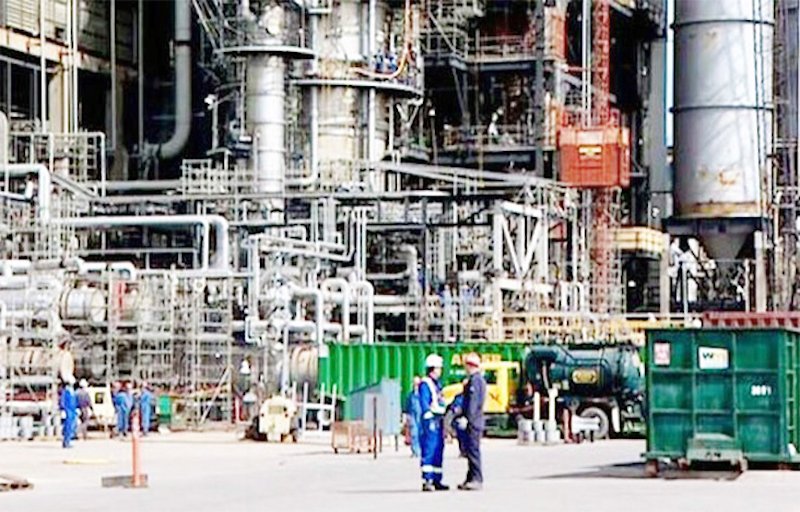
Africa’s richest man, Aliko Dangote, has revealed he is leaning toward Mombasa, Kenya, as the location for a 650,000-barrel-per-day oil refinery he intends to build in East Africa, a project that could transform the continent’s energy landscape and reduce its dangerous dependence on imported refined petroleum products.
In an interview with the Financial Times, Dangote said of Mombasa: “I’m leaning more towards Mombasa because Mombasa has a much larger, deeper port.” He also pointed to Kenya’s relative economic strength, noting that “Kenyans consume more. It’s a bigger economy.” His comments came after Kenyan President William Ruto had indicated in April that East African nations were in discussions to develop a joint oil refinery at Tanzania’s Tanga port, modeled on Dangote’s now-operating Nigerian refinery.
The Dangote Refinery in Lagos, Nigeria, which cost over $20 billion to build and has a nameplate capacity of 650,000 barrels per day, is already the largest single-train oil refinery in the world. Its success has demonstrated that Africa can build and operate world-class refining infrastructure. Now Dangote wants to replicate that model on the eastern side of the continent.
The timing is critical. The Iran war and the disruption of the Strait of Hormuz have exposed how profoundly vulnerable African nations are to global energy shocks. Fuel supply chains across the continent have fractured, with rising pump prices feeding directly into food costs, transport costs, and inflation in country after country. Kenya’s Bolt has raised ride-hailing fares by 6 percent. Mozambique’s inflation rate has climbed to a six-month high. Nigeria, despite being a major oil producer, continues to suffer petrol shortages due to inadequate domestic refining capacity.
Kenya’s own oil production story adds another layer to this East African energy narrative. Commercial production from the South Lokichar oilfields in Turkana County is expected to begin before the end of 2026, with initial output ranging from 20,000 to 50,000 barrels per day. Energy Cabinet Secretary Opiyo Wandayi has confirmed the timelines, while acknowledging that Kenya’s refining ambitions depend on scaling production beyond 100,000 barrels per day before domestic refining becomes economically viable.
For East Africa as a region, the convergence of Kenya’s emerging crude production and Dangote’s refinery ambitions creates a strategic opportunity that has not existed before. A large-scale refinery in Mombasa could process not only Kenyan crude but also supply refined products to landlocked countries including Uganda, Rwanda, South Sudan, and the Democratic Republic of Congo, all of which currently rely heavily on expensive imported fuel.
Uganda’s parliament this month passed the Protection of Sovereignty Bill, new legislation aimed at reducing foreign influence in the country’s governance. President Yoweri Museveni, freshly inaugurated for a seventh term, has called for an end to raw commodity exports across Africa and pushed strongly for value addition. A domestic refining industry in East Africa would align directly with that vision, keeping more of the economic value generated from the region’s resources within Africa rather than exporting it abroad.
Industry analysts note that with strategic investment, African oil production could fill a meaningful portion of the global supply normally transiting the Strait of Hormuz. The continent’s oil production has consistently underperformed relative to its reserve base, largely because of inadequate refining infrastructure, poor logistics, and underinvestment. Dangote’s project, if it proceeds in Mombasa, could change that calculus fundamentally.
Read More: Nigeria’s NNPC-China Refinery Deal and Dangote IPO Signal Africa’s Most Ambitious Energy Pivot in a Generation
Investment interest in African energy infrastructure is building from multiple directions. The Africa Ecosystem Catalysts Facility, a $4 million vehicle managed by Village Capital, made its first two investments in Ghana this month. Startup funding across the continent reached an estimated $110 to $145 million across 34 deals in April 2026 alone, with energy among the top recipient sectors alongside fintech, mobility, and agtech.
The decision on the refinery’s location is expected within the coming months. Both Kenya and Tanzania are actively courting Dangote with incentives, land access, and infrastructure commitments. Whichever port wins, East Africa’s energy future looks meaningfully different because of this conversation.


