
Sunday, May 10, 2026 | By The Africa Standard Political Desk
Africa’s political landscape in 2026 looks simultaneously like a continent in crisis and a continent on the verge of transformation. The crises are real and immediate: a spreading jihadist insurgency that has moved beyond the Sahel into anglophone West Africa, a catastrophic war in Sudan that threatens to merge with South Sudan’s instability, elections in Ethiopia and Somalia taking place amid active armed conflict, and a West African coup contagion that claimed Guinea-Bissau in November 2025 and nearly toppled the government of Benin in December. The transformation is real too, driven by a generation of Africans under 35 who are connected, angry, and increasingly unwilling to accept the political arrangements their parents inherited.
Ethiopia stands at the center of Africa’s electoral calendar this year. Prime Minister Abiy Ahmed, who won the Nobel Peace Prize in 2019 for ending the conflict with Eritrea and then presided over a devastating civil war in Tigray that killed an estimated 500,000 people, faces a national election in a country still managing the fragile aftermath of that conflict. The National Electoral Board of Ethiopia revoked the Tigray People’s Liberation Front’s legal status as a political party in May 2025 for failing to meet registration requirements, removing the region’s most prominent political organization from formal participation. Critics argue the move deepens Tigrayan disenfranchisement and increases the risk of a return to violence.
Ethiopia’s elections are also complicated by the country’s escalating tensions over regional access to the sea. Landlocked and entirely dependent on the port of Djibouti for 90 percent of its trade, Ethiopia under Abiy has been pursuing alternative port arrangements, including a controversial memorandum of understanding with Somaliland that angered Somalia and strained relations across the Horn of Africa. With East Africa’s largest economy at approximately $150 billion, Ethiopia’s political stability has consequences that reach well beyond its own borders.
Somalia’s situation is more acute. The federal government in Mogadishu continues to fight Al-Shabaab, the jihadist group affiliated with Al-Qaeda that controls significant territory across the country. National elections scheduled for 2026 face genuine uncertainty over security, logistical capacity, and political consensus. The African Union’s mission in Somalia, recently restructured, is attempting to create conditions for a credible electoral process, but the gap between the conditions required and those currently in place remains substantial.
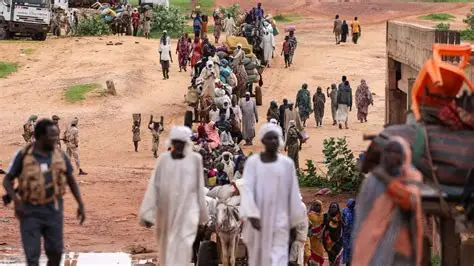
The Sudan crisis has reached a potentially catastrophic threshold. The Rapid Support Forces and the Sudanese Armed Forces continue fighting a war that the United Nations has described as producing the world’s largest humanitarian emergency, with an estimated 25 million people facing acute food insecurity. The RSF’s formation of a rival government in alliance with a faction of South Sudan’s governing movement has alarmed analysts who fear the two conflicts are merging. If Sudan’s war spills more deeply into South Sudan, the consequences for the region would be devastating, potentially displacing millions more people and destabilizing the East African security architecture.
In West Africa, the coup contagion that has already claimed Mali, Burkina Faso, Niger, Guinea, and Guinea-Bissau in recent years shows no sign of abating. The ECOWAS bloc, which attempted to reverse the Niger coup through threatened military intervention in 2023 and ultimately failed, faces a legitimacy crisis of its own. The Sahel’s three military juntas have expelled French forces, invited Russian Wagner Group successors, and turned their backs on regional integration frameworks. The instability is now spreading into coastal countries that previously appeared insulated from it.
Benin’s near-miss coup in December 2025 rattled a government that had been regarded as one of West Africa’s more stable democracies. The attempt reflected deep grievances over economic inequality, youth unemployment that exceeds 40 percent in key demographics, and perceptions that democratic governments serve elite interests rather than ordinary citizens. These grievances are not unique to Benin. They are structural features of governance across much of West Africa, making the region a pressure cooker.
Read More: Africa’s Digital Economy at a Crossroads as Gulf and Asian Investors Fill Western Funding Gap
Gen Z’s role in African politics has become impossible to ignore. Young Africans, equipped with smartphones, social media fluency, and firsthand experience of governance failures, are organizing in ways that conventional political parties and security forces are struggling to contain. Nigeria’s 2023 elections showed how youth mobilization can reshape electoral dynamics without yet achieving political power. Kenya’s 2024 budget protests forced the government to withdraw proposed tax increases under mass street pressure. Senegal’s 2024 electoral upheaval produced a surprise opposition victory. Across the continent, the pattern is consistent: young people are arriving as a political force that entrenched systems were not designed to accommodate.
The African Union’s response to the continent’s compounding crises has been criticized as too slow and insufficiently resourced. Observer missions are dispatched to elections, frameworks are endorsed in communiques, and strongly-worded statements are issued after coups. But the structural reforms that would address the governance failures driving instability, including genuine electoral independence, civilian oversight of security forces, and transparent resource revenue management, require political will that many incumbent governments lack precisely because those reforms would constrain their own power. Africa’s 2026 political moment is a test the continent cannot afford to fail


