
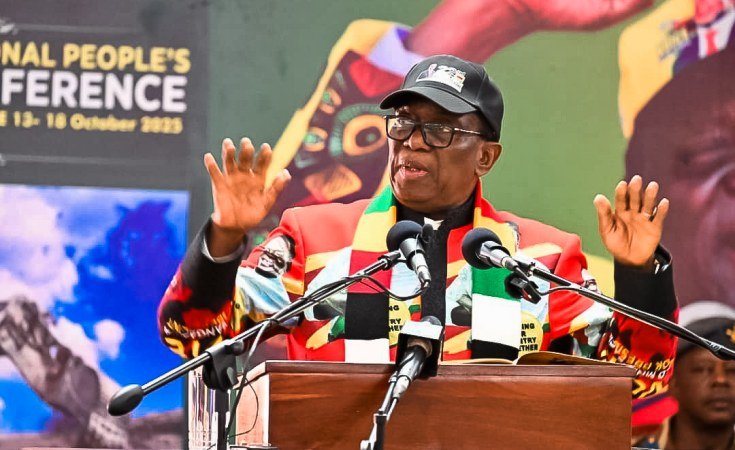
Constitutional law expert Professor Lovemore Madhuku has dismissed Zanu PF’s growing campaign to extend President Emmerson Mnangagwa’s rule beyond the constitutional limit, calling the move illegal and impossible under Zimbabwe’s current laws.
Speaking to 263Chat, Professor Madhuku said there was no lawful pathway to allow Mnangagwa to remain in office after his second term ends in 2028. His remarks come amid growing speculation that the ruling party intends to manipulate the constitution to stretch Mnangagwa’s tenure until 2030.
“We do not know how they intend to do it. They have not indicated how they would want to amend the constitution, but what is very clear is that it is not possible to ensure that when the president’s term ends in 2028, he remains in office beyond that,” said Madhuku.
He added firmly, “There is no legal mechanism of doing it as it currently stands.”
The proposal to extend Mnangagwa’s rule was first floated during Zanu PF’s 2024 Bulawayo Congress, where delegates endorsed a motion to “retain leadership continuity.” The resolution has since become one of the most polarising topics in Zimbabwean politics.
Political analysts argue that Mnangagwa’s allies are attempting to secure his continued leadership through what they describe as “constitutional manipulation” and “elite bargaining” within Zanu PF and Parliament.
Section 91(2) of Zimbabwe’s Constitution limits a president to two five-year terms, while any amendment affecting presidential term limits or tenure requires a national referendum.
Madhuku said any attempt to extend Mnangagwa’s stay without consulting the people would be a clear violation of the Constitution.
“The kind of amendments they are talking about are not possible without a referendum. There are a few things you can amend without one, but if you want to tamper with the term of office of the president, or the structure of the state, you cannot avoid the people’s input,” he said.
“This idea of avoiding a referendum means they know this proposal is not popular with the people,” Madhuku added.
The move has revived memories of former President Robert Mugabe’s long rule, which lasted 37 years before he was ousted in a military-backed coup in 2017 led by Mnangagwa and then-General Constantino Chiwenga.
Observers fear that Mnangagwa’s attempt to prolong his rule could deepen divisions within Zanu PF and destabilize Zimbabwe’s fragile political environment.
Exiled former minister Jonathan Moyo has been linked to a controversial document known as the “Breaking Barriers Initiative,” which reportedly outlines strategies to extend Mnangagwa’s term and suspend future elections.
Moyo argues that Mnangagwa’s term could be legally extended by amending Section 95(2)(b) of the Constitution, which defines the duration of the presidential term, without triggering the referendum requirement under Section 328.
He posted on X, formerly Twitter, “Amending Section 95(2)(b) to seven years would simply recalibrate this flexible duration, enabling an extension to 2030 via a two-thirds vote in Parliament, free from the dictates of sections 328(6)-(9).”
Critics have called Moyo’s argument “a dangerous distortion of constitutional law” designed to justify political manipulation and undermine democratic accountability.
According to political insiders, Mnangagwa’s allies view the extension as a way to secure the political and business interests of those closely aligned with him, including billionaire businessman Kudakwashe Tagwirei, who recently joined Zanu PF’s Central Committee.
For Vice President Constantino Chiwenga, who has long been seen as Mnangagwa’s successor, the push to extend the president’s term could derail his ambitions, fueling renewed factional tensions within the ruling party.
Analysts warn that Chiwenga’s camp may resist any attempt to sideline him, potentially setting the stage for another internal showdown similar to the 2017 coup that brought Mnangagwa to power.
Madhuku cautioned that any political party trying to rewrite the Constitution for personal gain would be acting outside the bounds of democracy.
“It is wrong for any political party on its own to want to impose a constitution on the people,” he said.
He emphasized that term limits exist to prevent even the most competent leaders from overstaying their mandate. “Term limits are actually imposed to limit very good presidents. They were invented to ensure that a person would not remain in office merely because they were doing well.”
“Term limits are for good presidents. You do not need term limits for a poor president who will obviously be removed in an election,” he added.
The debate has ignited public outrage across Zimbabwe, with civil society groups and opposition parties warning that the move would mark a return to authoritarianism.
Legal experts, including those within academia and the Law Society of Zimbabwe, have begun preparing position papers challenging any proposed amendment that bypasses the referendum requirement.
Madhuku’s firm stance adds weight to growing opposition against the alleged plan, reinforcing calls for constitutional respect and democratic accountability.
As Mnangagwa faces increasing scrutiny at home and abroad, his legacy now hangs on whether he upholds the constitutional order or repeats the excesses that marked Zimbabwe’s past.


