
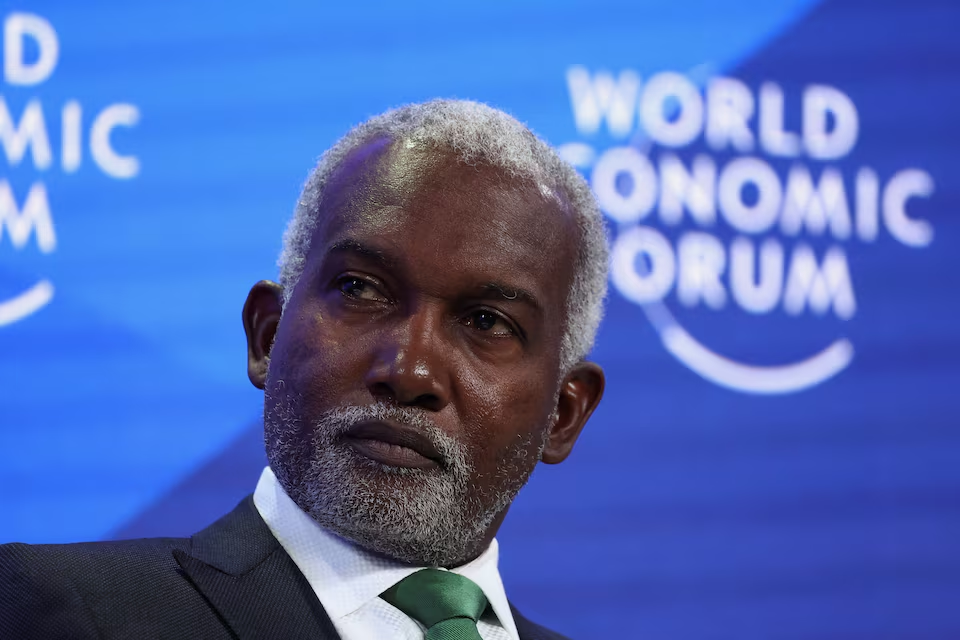
Nigeria’s Foreign Minister Yusuf Tuggar has said that tariffs imposed by the United States do not harm Nigeria as much as they do other countries. He made the remarks during an interview at the Reuters NEXT Gulf Summit held in Abu Dhabi on Wednesday.
Tuggar explained that Nigeria’s diversified trade partnerships have helped cushion the country from the negative effects of U.S. tariff measures.
He said Nigeria’s economic strategy is focused on maintaining balanced relations with multiple global partners rather than depending heavily on one major economy.
“Our approach to foreign trade is not about aligning with one particular axis,” Tuggar said. “We are building relationships with China, Brazil, India, and others while maintaining our sovereignty in decision-making.”
The minister noted that Nigeria’s trade with the United States remains important but is no longer the dominant pillar of the country’s foreign economic relations.
According to Tuggar, Nigeria’s growing trade with emerging markets has strengthened its economic resilience and reduced vulnerability to external shocks.
He said the government’s current policy direction is designed to ensure that Nigeria benefits from global trade without being overly exposed to the actions of any single partner.
“Diversification is not just an economic principle for us, it is a matter of national strategy,” Tuggar added.
The comments come at a time when global trade dynamics continue to shift amid tariff tensions between the United States and several trading partners.
Tuggar emphasized that while tariffs imposed by Washington may have created disruptions for some economies, Nigeria’s limited export exposure to the U.S. has shielded it from severe consequences.
He pointed out that Nigeria exports a diverse range of goods and services across different regions, which helps to balance its trade risks.
Recent data from the Nigerian Export Promotion Council (NEPC) shows that Asia now accounts for a growing share of Nigeria’s non-oil exports, led by China and India.
Brazil has also emerged as a key destination for Nigerian agricultural products, creating new opportunities for farmers and exporters.
The minister said these relationships are part of Nigeria’s broader goal of achieving what he described as “strategic autonomy.”
Strategic autonomy, according to Tuggar, means that Nigeria can engage globally on its own terms without being dependent on or pressured by any one power bloc.
He said this approach is crucial for maintaining national sovereignty and promoting long-term economic sustainability.
Tuggar also highlighted ongoing government efforts to deepen economic integration within Africa through the African Continental Free Trade Area (AfCFTA).
He said that regional trade remains a top priority for Nigeria as it works to strengthen intra-African supply chains and reduce reliance on imports from outside the continent.
Nigeria’s pursuit of industrialisation and export diversification, Tuggar said, aligns with this vision of greater regional self-reliance.
He added that the government is investing heavily in manufacturing, digital technology, and renewable energy to boost competitiveness in global markets.
The minister reaffirmed that while Nigeria maintains strong diplomatic and commercial ties with the United States, it will continue to make decisions that prioritize its national interests.
He said Nigeria’s long-term objective is to become a self-sufficient and competitive economy that can engage all partners from a position of strength.
Observers at the Reuters NEXT Gulf Summit noted that Tuggar’s comments reflect a broader trend among African nations seeking more balanced trade relationships with global powers.
Economists say Nigeria’s cautious yet confident stance illustrates the country’s growing assertiveness in shaping its own economic destiny.
Tuggar concluded by saying that Nigeria’s future lies in pragmatic diplomacy, sustainable trade, and strategic partnerships that reflect the aspirations of its people.


