
In a rural corner of north-eastern Nigeria, women bend over rows of vegetables, watering and weeding under the scorching sun. Just a few meters away, men in uniform stand watch, their rifles glinting in the light. These are Agro Rangers, a special security unit created to protect farmers from Boko Haram and Islamic State West Africa Province (ISWAP) fighters who stalk the fields of Borno State.
“There is fear. We fear for our souls,” says 50-year-old farmer Aisha Isa, as she tends to her small plot in Dalwa village. “We will take the risk and come even if the rangers are not coming.”
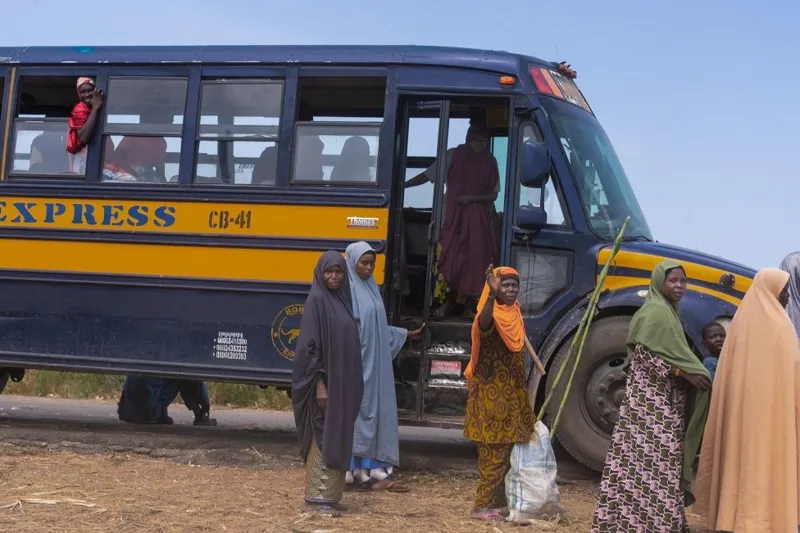
Aisha and her family fled their home 11 years ago when insurgents attacked their village. Now, she lives in temporary housing and is bused daily from Maiduguri, the state capital, to this guarded farmland where the army has dug protective trenches.
For many displaced Nigerians like Aisha, farming remains the only way to survive. But the threat of militant attacks hangs over every harvest season.
“We have been hearing people are being kidnapped,” says Mustapha Musa, a 42-year-old father of ten. “Some are killed. That is why I am scared and don’t want to come without security protection.”
Musa fled his home in Konduga more than a decade ago and refuses to return until peace is restored. “Until there is lasting security, we cannot go back,” he tells Africa Standard.
The insurgency in north-eastern Nigeria is now in its 15th year. Thousands have been killed and millions displaced. Attacks on farmers have intensified this year, with fatalities more than doubling compared to 2024, according to data from the Armed Conflict Location and Event Data (ACLED) project.
Despite the worsening violence, Borno State Governor Babagana Zulum is accelerating efforts to resettle displaced people as part of his stabilization agenda. The government argues that restoring agriculture will reduce hunger and dependency.
The United Nations warns that nearly four million people in the region face food insecurity. However, aid agencies caution that pushing people back to unsafe farmlands may put lives at risk.
The International Crisis Group says militants continue to extort farmers, forcing them to pay “taxes” in exchange for access to their own fields. In some cases, those unable to pay face brutal consequences.
Abba Mustapha Muhammed, a farmer who was kidnapped with nine others earlier this year, recalls the horror of being held captive. “One man was killed because his family couldn’t raise the ransom,” he says. “They threw his body away and told his relatives to come collect it.”
Abba spent three days in the forest with little food or water. “The little meals they gave us made us sick. We were always hungry,” he recalls. Now free, he refuses to return to the fields. “The insurgents are still lurking. Just yesterday they abducted ten people.”
Despite such fears, the commander of the Agro Rangers in Borno, Mohammed Hassan Agalama, insists the presence of armed guards has reduced attacks. “The terrorists know we are on the ground, so they avoid the farms,” he says.
The Agro Rangers operate under the Nigeria Security and Civil Defence Corps (NSCDC). Their mission is to escort farmers and secure farmlands. But with only 600 officers available, the unit is stretched thin.
“We cannot be everywhere,” admits NSCDC spokesperson James Bulus. “Can 600 Agro Rangers cover all farms in Maiduguri? No. But the harvest shows that normalcy is gradually returning.”
However, analysts disagree. ACLED’s Ladd Serwat says civilian deaths linked to jihadist attacks on farmers are at their highest in five years. “The violence is far from over,” he says.
In Maiduguri’s city center, farmers gather at the home of Adam Goni, head of the local sorghum producers’ association. They sit under a tree, sharing stories of fear and loss. Among them is Baba Modu, who lost his nephew to Boko Haram gunmen.
“They killed him like an animal,” Modu says softly. “The killings are too much. This year is the worst. Even at home, I sleep with my eyes open.”
Modu says militants now demand ransom and still kill their victims. “At first, they took the money and released people. Now they take the money and still kill,” he laments.
He adds that even soldiers sometimes flee during militant attacks. “Sometimes the security operatives run away when they see the insurgents. We are left alone.”
Goni, tending to his small potato patch, says he has 10 hectares of crops waiting for harvest just eight kilometers away, but he is too afraid to go. “The man who owned the neighboring farm was killed there,” he says. “There is no safety. We are just taking risks.”
Frustrated and weary, Goni says the government has the capacity to end the conflict. “If they are serious, Boko Haram will end in a month,” he says angrily.
Bulus from the NSCDC insists progress is being made. “Peace is gradual,” he tells Africa Standard. “It cannot be achieved in one day.”
For the farmers, however, patience has run out. Fifteen years after the war began, they remain trapped between hunger and death.
Many now farm behind trenches and fences, watched over by armed men who themselves are targets. Each day they sow seeds of hope in soil soaked with fear, praying to return home someday without the need for guns to guard their food.
The Nigerian military has yet to respond to Africa Standard’s request for comment on the farmers’ complaints about inadequate protection.
For now, the sound of gunfire remains a familiar echo across Borno’s farmlands, where the fight to grow food has become a fight for survival.


